

Scoring
There are two main scores currently used for payouts:
- Alpha: Your neutral-weighted predictions multiplied by the
chilitarget - Meta Portfolio Contribution (
MPC): Your predictions' contribution to the Meta Portfolio
We also have informational scores not currently used for payouts:
- Correlation (
CORRv4): Your prediction's correlation to the target - Information Coefficient (
ICv2): Your prediction's correlation to raw returns - Residual Information Coefficient (
RIC): Your prediction's correlation to residual returns (returns neutralized to common factors) - NCORR: Your prediction is neutralized with the Signals v3 giant neutralizer, then correlated with the Jupiter 60D2L target
- NMMC: Your neutralized prediction's contribution to the v3 neutral stake-weighted Meta Model (
v3NUSWMM), evaluated against the Jupiter 60D2L target
NCORR and NMMC are displayed for research and do not currently determine payouts. Missing historical values are shown as unavailable, not as zero. Legacy MMC and FNCv4 history remains available through the API but is no longer shown as a current Signals score choice.
Planned Jupiter payouts — not active
The planned payout weights are 0.5 × NCORR + 2 × NMMC, replacing the current 0.3 × Alpha + 0.8 × MPC. The payout change is planned to start with round 1363, opening September 25, 2026. Scores remain Jupiter 60D2L; this does not mean earlier settlement. Rounds before round 1363 retain their original payout rules. See planned Jupiter payouts for the payout factor, clip, and rollout boundaries.
For a full list of detailed explanations please see the definitions docs.
Leaderboard eligibility
A Signals model must have both NCORR and NMMC reputations to appear on the leaderboard. Its account must be verified and the model must not be archived. These reputations use fully resolved 60-day scores. Partial round scores and legacy 20-day reputations do not qualify a model for inclusion.
Neutralization
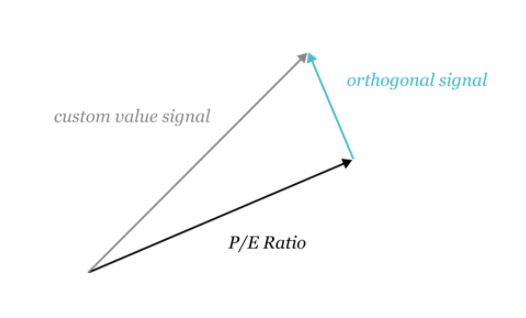
A signal or target is considered "neutral" when it has zero correlation with some set of existing signals. The point of the neutralization is to isolate the original or orthogonal component of the signal that is not already present in existing signals.
WARNING
If you submit a simple linear combination of a few well-known signals, there will be little to no orthogonal component after neutralization.
Numerai has a variety of existing signals including Barra factors (like size, value, momentum, etc.), country and sector risk factors, and custom stock features. Not all of these existing signals are provided to you, which makes this process somewhat "blackbox".
By neutralizing your signal before scoring, Numerai aligns it with the neutralized target which may improve its performance against the target without Numerai having to give out the data used for neutralization. For example, if your signal is not neutralized to country risks, Numerai Signals will neutralize your signal against country risks before scoring. This allows you to focus on creating an original signal without having to worry about country risk neutralization.
A signal may have strong predictive power when considered alone, but could score poorly on Numerai Signals due to this neutralization. This highlights the key unique aspect of Signals: Numerai Signals is not about predicting stock returns, it is about finding original signals that Numerai doesn't already have.
The Target
Signals are evaluated against a custom blackbox target that is neutralized against our existing signals.
We provide both 20D2L and 60D2L targets in our dataset. We do not use shorter time horizons because signals that only work on short time horizons are nearly impossible for large hedge funds to trade. For example, even if a signal can accurately predict the 1 hour return of stocks, it is not very useful if it takes a hedge fund 24 hours to fully trade into that position. Signals that are most useful to large hedge funds have predictive power over a long time horizon which is also known as having "low alpha decay".
Grandmasters
Grandmasters place first
Masters place in the top 10
Experts place in the top 25%
Researchers place in the top 50%
Contributors place in the top 75%
Apprentices place in the bottom 25%
Novices have not yet made 20 qualified submissions
Canon Scores
Canonical Scores (or “Canon Scores”) combine metrics across scoring changes. FNC was a Signals payout metric before Alpha replaced it. The payout score changed from 'CORR20' to 'FNCv4' at round 499. The 'Canon FNC' series combines 'CORR20' for rounds up to and including 498 and 'FNCv4' for rounds thereafter.
Canon Alpha and Canon MPC each track their own metric and are the scores to read for current Signals payouts. Canon CORR and Canon MMC remain continuous legacy series: past the rounds where Signals last selected an exact CORR or MMC source, they follow the payout metric that replaced it (FNC, then Alpha, and MPC respectively). Prefer Canon Alpha and Canon MPC when you need a specific metric, and do not read Canon CORR or Canon MMC as exact CORR or MMC values for recent rounds.
Diagnostics
You can use the historical diagnostics of your signal to check performance and estimate the impact neutralization may have on your signal in the future. It’s important to note that signals with strong scores over the historical period may not score well in any current or future round.
The diagnostics tool can be opened using the beaker next to your model on the scores page. Upload a signal over a historical validation time period and it will calculate validation metrics including performance, risk, and potential earnings. The validation time period starts on 20130104 and ends on the latest date in the validation data.
Uploads over the validation time period must include one extra column:
- A
datecolumn - historic data is weekly and the diagnostics tool assumes your predictions for a given week are made using market close data of the latest Friday
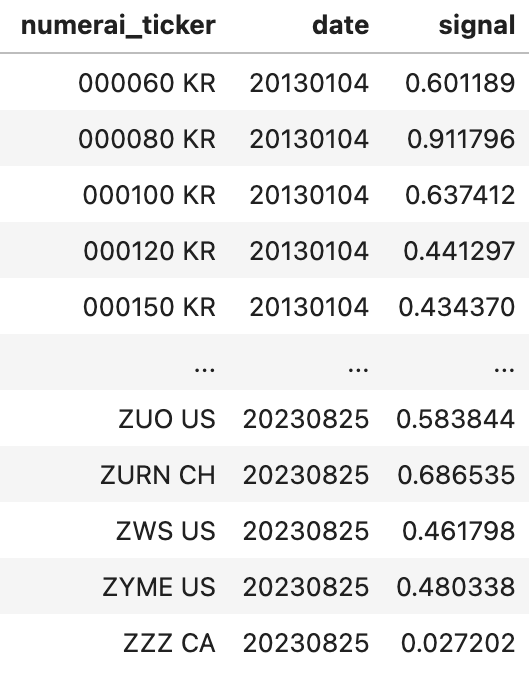
Once your upload is validated, diagnostics will start running. This usually takes 5-10 minutes depending on the number of weeks and tickers that span your submission.
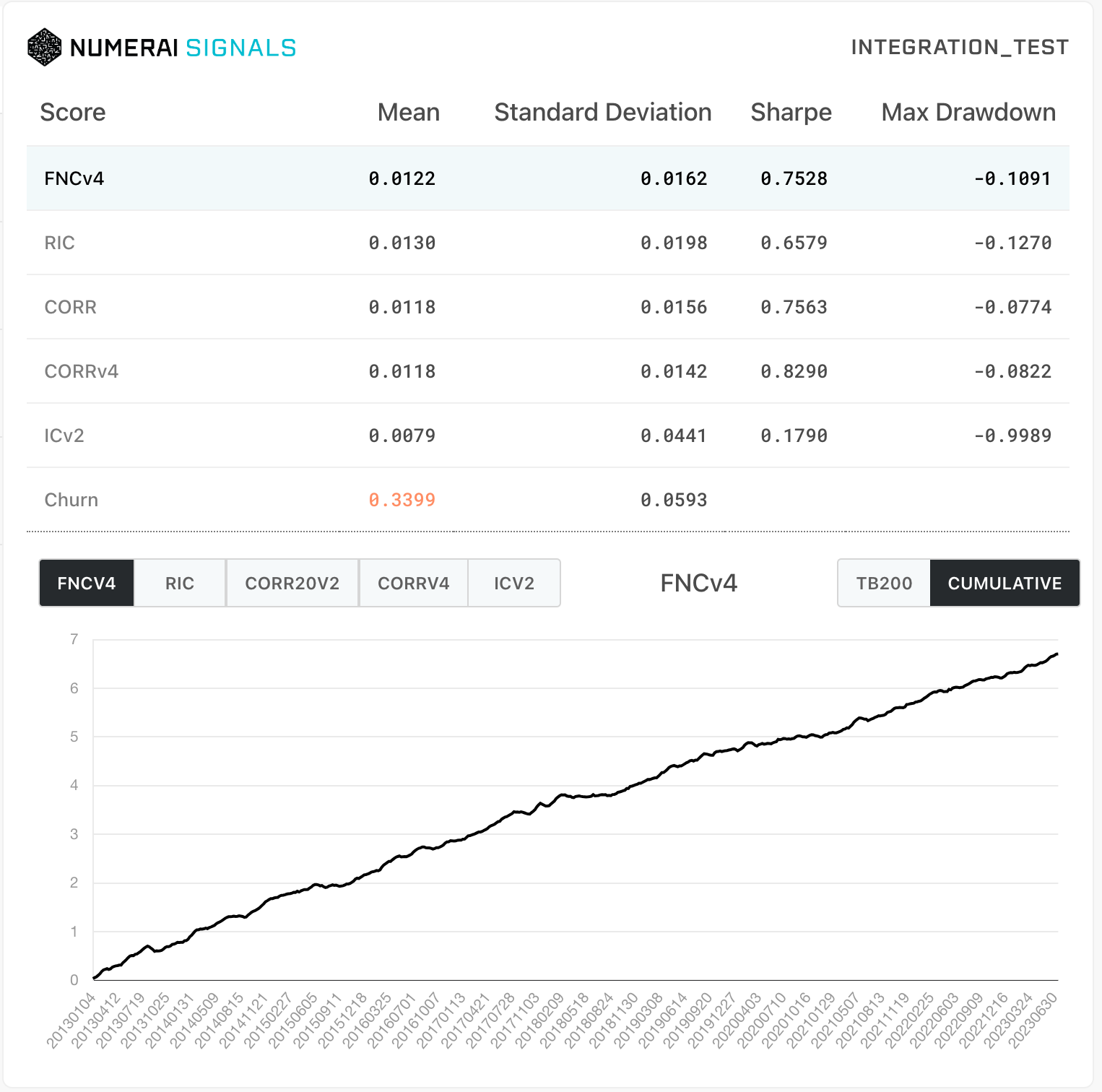
These diagnostics serve as a guide for you to estimate whether your signal is good enough to be worth staking on. It is important to note that signals with strong diagnostics over the historical validation period may not score well in any current or future live periods.
WARNING
Using this historical evaluation tool repeatedly will quickly lead to overfitting. Treat diagnostics only as a final check in your signal creation process.
What is neutral churn?
Churn describes how much a signal changes over time. Signals measures this after removing the effects captured by the neutralizer data for each week. The calculation is available in numerai-tools.
Use the Signals v3.0 neutralizers for both submissions, with each submission's matching data date. Rank the available predictions on the full dated universe, then fill missing ranks with 0.5 before Gaussianizing and neutralizing. Keep the full neutralizer universe, including stocks you did not submit. Neutral churn does not use v2.1 neutralizers or sample weights. For the numerai-tools mean helper's sample-weight arguments, pass a series of ones indexed by each date's full v3.0 neutralizer universe.
Published live snapshots are used when available. Older submissions without a published live file use the historical v3 neutralizers.
In short:
neutral_churn(t0, t1) = 1 - rank_correlation(neutral_signal(t0), neutral_signal(t1))
Why calculate neutral churn?
Lower neutral churn means a model's distinct signal is more stable from week to week. This makes it easier to use in the Signals Meta Model.
Mean neutral churn
When you upload a submission, Signals compares it with your selected, on-time submissions from the five preceding rounds. Missing rounds do not extend the window further back into your history. For a late submission, the window shifts forward one round to include the round that just closed. The reported value is the mean of those neutral-churn comparisons:
mean_neutral_churn = mean([neutral_churn(current, recent_1), ..., neutral_churn(current, recent_5)])
If no comparison can be calculated, the reported value is 1.0. Signals no longer calculates turnover during submission validation. Neutral churn does not reject a submission or set its stake to zero.
Neutral-churn payout penalty
Starting with Signals round 1369, opening October 3, 2026, positive payouts are reduced based on mean neutral churn. Rounds before 1369 retain their original payouts, even when scored or resolved after the cutoff. The fraction of a positive payout retained is:
Retained fraction = min(1, 2 / (1 + exp(10 × (mean neutral churn − 0.1))))
Positive payouts are unchanged through mean neutral churn 0.1. Above that, the retained fraction decreases smoothly: about 53.79% at 0.2, 23.84% at 0.3, and 3.60% at 0.5. The no-history value 1.0 follows the same curve, retaining about 0.024679%; it is not a hard zero or an exemption.
Apply the penalty after the payout factor and clipping. Zero payouts and negative payouts (burns) are unchanged. It does not reduce nominal stake, change submission eligibility, or alter Jupiter payout-score weights.
On a model's profile, the Churn multiplier column shows this retained fraction, rounded to four significant digits, for each resolving and resolved round, alongside mean neutral churn. A multiplier of 1× means no reduction to a positive payout; rounds before 1369 also show 1×. Missing mean neutral churn is shown as unavailable, not as zero churn or no penalty. The multiplier is also shown in the mobile round cards.